A robot is a deck with wheels
A small service robot rolls into the hallway at seven in the morning. Last night you told your assistant that the children sleep until eight and the house should stay quiet. The robot never heard that conversation. It has its own app, its own account, its own cloud and its own idea of when the hallway gets cleaned. It also has a detailed map of your home, stored on a server you have never seen, and when the Wi-Fi drops it stops in the middle of the corridor and waits for instructions from that server.
There is no malice in any of this. It is simply a second assistant that does not know you, in a body with real mass.
The real cause: the robot was built as a separate product
Most household robots are designed as a closed product: hardware, app, account and cloud, sold together. The robot’s intelligence belongs to the vendor, so does its memory, and its safety rules live in the same software that plans its next move — often partly in the vendor’s cloud. Your assistant, if you have one, is a guest that can at best send it a command.
Where household robots go wrong
A stranger with a map of your home. The map, the schedule and the camera frames belong to an account you do not control, under a policy you did not write.
A second assistant that does not know you. What you told your assistant does not reach the robot, and what the robot sees does not reach your assistant. Two systems, two memories, constant re-explaining.
Safety inside the planner. When the same software decides where to go and whether going there is allowed, a bad plan and a broken limit become the same failure.
Safety in the cloud. If limits are checked remotely, a lost link leaves the machine with undefined behaviour at exactly the moment nobody is watching.
No record. When something goes wrong — a scratched door, a toy pushed down the stairs — there is no trace you can read, so the incident gets guessed at rather than reconstructed.
The same assistant, with mass
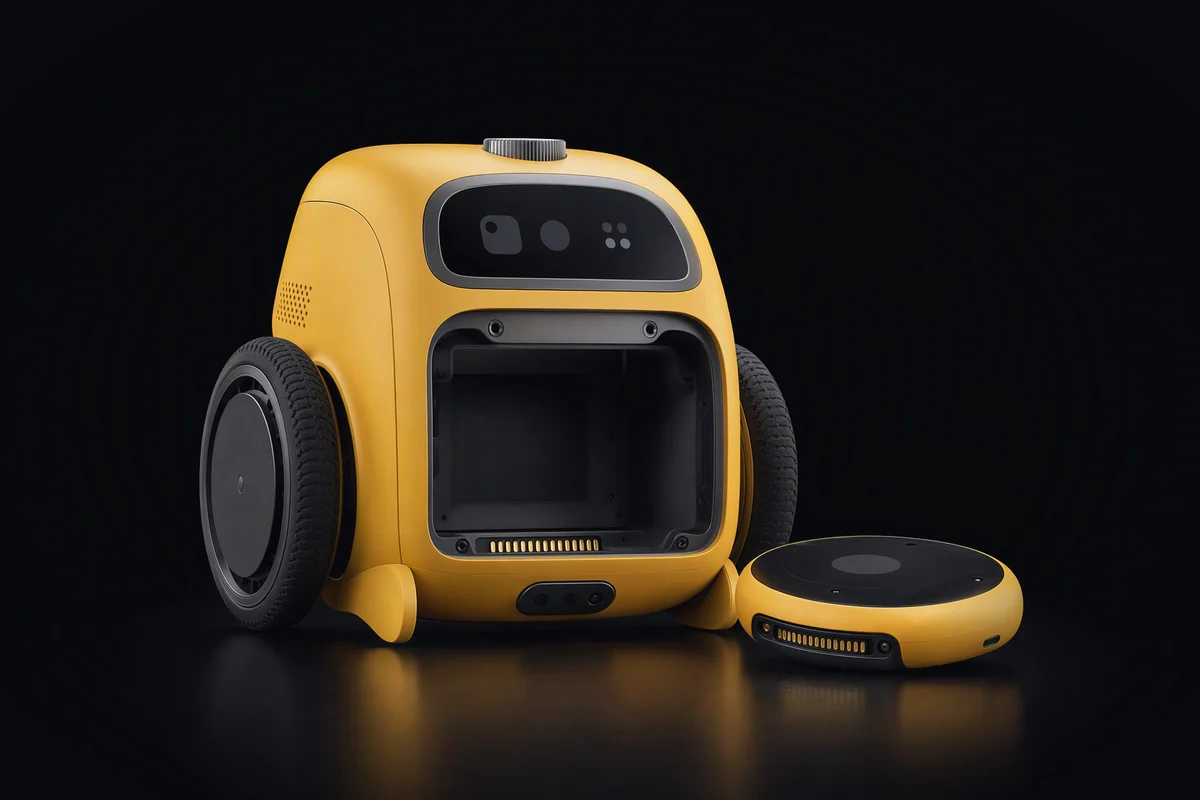
KyberDeck Core is our answer: a compute module that slides into a robot’s compute bay, with KyberLinux and KyberBot on board. The robot stops being a separate product and becomes one more body for the assistant you already have, under the same identity as your card and your band. What you said at dinner is context it has; what it sees in the hallway becomes memory your assistant keeps.
With mass come rules, and the rules have a specific place.
Limits below the planner. Where the machine may go, how fast, what it may touch: together these form a safety envelope that KyberBot enforces on board, beneath the planning layer. A plan that breaks the envelope never becomes motion. How KyberBot carries that envelope — the harness that holds the limits and the homeostat that keeps the machine in a safe state — is the subject of KyberBot in a robot.
Local first, always. The envelope is checked on the module, not in a data centre. When the network drops, the robot keeps its limits and stops safely instead of waiting for a server.
Heavy thinking is handed off. When a job is bigger than the robot — planning a week of chores, reading the manual of a new appliance — KyberBot hands it to a swarm of KyberAgent agents, each working in its own KyberCell, and only the result comes back to the body. An agent in a cell explains why that isolation matters when whatever receives the plan can move.
Every motion on the record. Each movement is written down together with the decision that caused it, so an incident can be reconstructed rather than guessed at. The same principle, applied to agents, is in every step on the record.
Now the honest edges. Core is in design, not shipping. It is not a safety certification, and a well-behaved module cannot make a badly built robot safe: the envelope enforces limits, but the mechanics, brakes and sensors still have to be sound. The other four forms are on the homepage, and the case for the robot and the card sharing one assistant is in the five forms of KyberDeck.
A test you can run today
If you have a robot vacuum, a robot mower or any machine at home that moves by itself, try three things this week.
- Find the map. Open its app and look for where the map of your home is stored, and whether you can export or delete it. If you cannot find out, that is the answer.
- Pull the network. Block its Wi-Fi at the router in the middle of a run. Does it stop safely, carry on, or stand in the corridor and wait?
- Ask for yesterday. Try to get a record of where it went and when. A route drawn in the app counts; “cleaning complete” does not.
Three clear answers mean the machine is at least legible. Three shrugs mean there is a body in your home that belongs to somebody else.
- robots
- KyberDeck Core
- safety
- KyberBot