Glasses with a puck: what XREAL Aura teaches about form
You are at a workbench with both hands inside a machine you are repairing, and you need the wiring diagram. Your phone is in your back pocket, face down, and the diagram is three taps and one greasy screen away. So you guess, or you stop, wipe your hands and lose the thread.
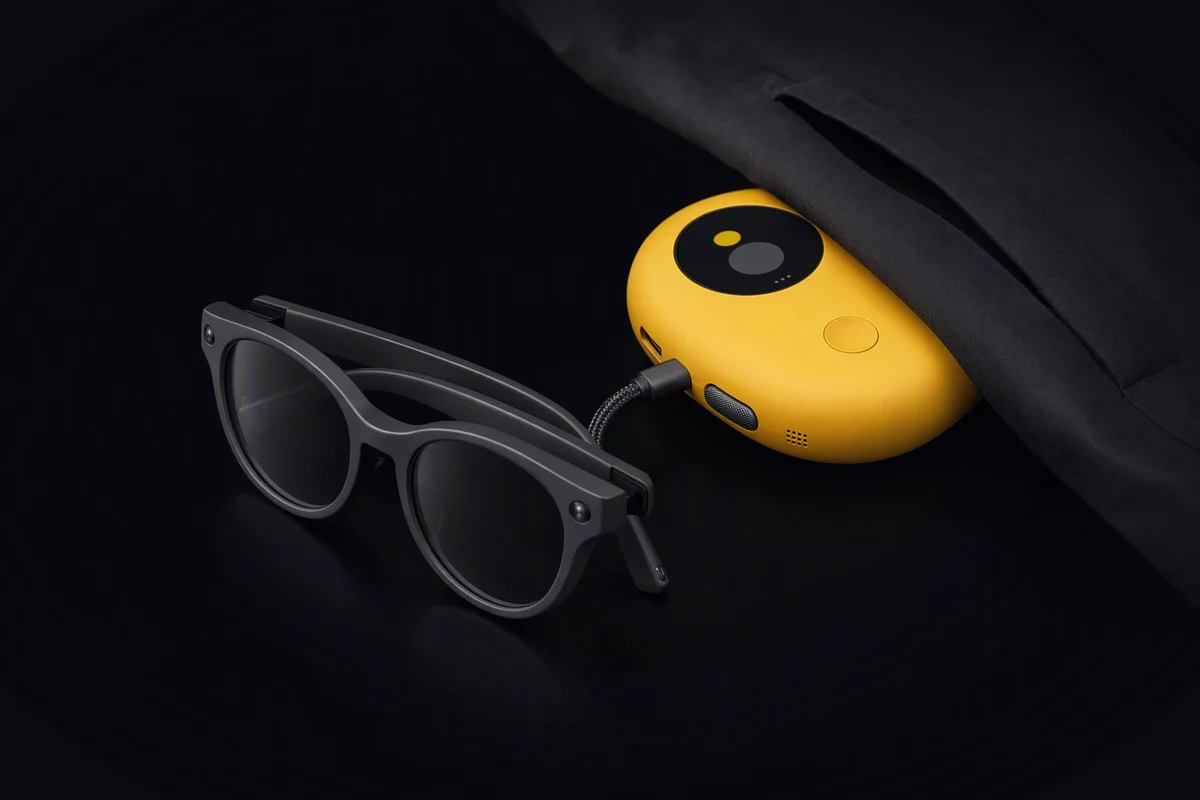
That is the job a computer on your face is supposed to do. On 7 October XREAL opened pre-orders for Aura, display glasses built with Google on Android XR, and the interesting thing about it is not the software. It is the shape: a pair of glasses joined by a cable to a puck that lives in your pocket.
The real cause: the face is the worst place for a computer
Everything that makes a computer useful is heavy, warm or both: the battery, the processor, the radios. The face is the place where weight hurts first and heat is felt most. Every wearable display has to decide what goes on the head and what goes somewhere else.
Aura’s answer is a clean split. The glasses, under 95 g, carry the optics (Sony micro-OLED, 1920×1200 per eye, up to 120 Hz, a 70° field of view, electrochromic dimming), two tracking cameras, a higher-resolution camera with a privacy LED, four microphones and a small spatial coprocessor, the X1S, which keeps the image steady when you move your head; XREAL puts the delay from motion to image at about 3 ms. The puck carries the rest: a Qualcomm Snapdragon Reality Elite rated at 48 TOPS, 12 or 16 GB of memory, a 4455 mAh battery, Wi-Fi 6E, Bluetooth 5.3, GPS and a fingerprint reader. It doubles as a trackpad.
That is, almost exactly, the argument we make for a pocket deck: put the sensors where the senses are, and the computer where your body can carry it.
What the split gets right, and what it costs
Weight leaves the face. Below 100 g, glasses stop being a headset you endure and start being eyewear you forget. Putting the battery in the pocket is what buys that number.
Heat and battery go where they can be big. A pocket can hold a 4455 mAh cell and a chip that gets warm. The temple of a pair of glasses cannot.
The cable is clumsy and honest. It snags on a jacket and it is one more thing to plug in. It is also visible: you can see where the computer is and unplug it. A wireless link would be tidier and would hide exactly that.
A camera with a light on it. The main camera has a privacy LED, which is good manners towards the people around you. A light says that the camera is on. It does not say where the frames go, and XREAL does not publicly set out which parts of the assistant’s work happen on the puck and which in the cloud. That is worth asking before you wear one into a meeting.
Identity on the part you hold. The fingerprint reader sits on the puck, not on the glasses. Unlocking happens on the part that is in your hand and stays with you.
A second port. The puck has a second USB-C port with DisplayPort input, and XREAL documents full ADB access. The glasses can be a screen for another computer, and the computer can be inspected. That matters more than any frame rate, and a pocket computer with ADB on KyberLinux looks at what it does and does not open up.
Price and reach. Aura starts at 1,279 USD (1,499 USD for 16 GB and 512 GB). The first shipments go to the US, Canada, Japan and South Korea, with more markets in 2027. Poland and the rest of the EU are not in the first wave, so for a European reader this is a shape to study, not one to buy this year.
How KyberDeck approaches the same shape
We do not make glasses, and KyberDeck does not run Android XR. What Aura shows is a lesson about bodies, and it fits the way the five forms of KyberDeck are split.
Split by job, not by fashion. What must sit at your eyes and ears goes there; everything else goes to the pocket. The Pocket is our clamshell deck with a real keyboard and small models on the device, and the reason it exists is the same reason Aura’s puck exists: a phone is the wrong body for an assistant when it has to be both the screen and the computer.
Sensors on the body, decisions in the pocket. The parts that see and hear should be as dumb as they can be, and the part that decides should be the one you can hold, lock and switch off. How much of that deciding can stay local is the subject of what stays local on KyberFusion.
A switch, not a setting. A camera on your face needs a cut you can trust more than a light. Our design is a physical switch wired to the sensor power, described in hardware that does not report on you.
A display as a peripheral. A pair of glasses with a display input is, in principle, a screen any pocket computer could drive over a cable. Whether the Pocket should do that is a question we are looking at, not a feature, and nothing here is for sale yet.
The other side of the question, whose system runs the body once you have one, is in Android XR and who owns the body. And the trust side, an assistant that sees everything you see, is on KyberBot.
A test you can run today
You can feel this shape without buying anything. Put your phone in a jacket pocket, run a charging cable from it up to the collar, and wear it, together with any pair of glasses or sunglasses, through an hour of normal work. Count how often the cable catches, and notice whether you stop noticing it.
Then write down the things you would want to see without using your hands. If the list is short, a display may not be worth carrying: according to Counterpoint, cited by Android Authority, 96% of the smart glasses shipped in the first half of 2026 had no display at all. If the list is long, you have just designed the split yourself. More on the bodies we are building is on the homepage.
- form factor
- XR glasses
- XREAL Aura
- KyberDeck Pocket